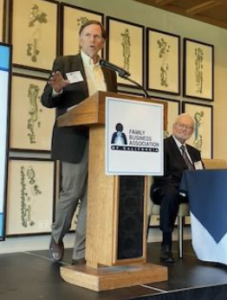
At FBAC’s recent Annual Meeting of Members, Chairman Ken Monroe urged family business owners around the state to join the Association because “we need to be our own advocate” in Sacramento.
Here’s the good news: Our reputation and ability to participate in much of the legislative action impacting family business is very strong. Bob Rivinius, Dennis Albiani, and Annalee Augustine have put our name on the Legislature’s map. They are regularly asked to participate with many other advocacy groups that we share interests with, because the FBA name means something to our legislators. The FBA is visible and impactful.
Now for the we-need-some-help news. Our membership is lagging. It’s a challenge to get people to come on board and we do need to continually grow membership, to keep our name visible in the Legislature.
We visit with a lot of family businesses at events like this, even going out and try to recruit people. And without exception, they all have significant concerns about the challenges the state puts in front of us to operate a healthy family business. But this is our challenge – we’ve all been guilty of this – and say, “There’s not much I can do,” or “I got too much on my plate right now. Maybe this will all work out if I just kind of close my eyes.” And I think everybody here recognizes that’s not a good strategy, and we’re going to have to help grow those members.
Let me add to your concerns, though. We at Holt joined the FBA because, like most of you, we recognize that while there are many business organizations out there, they don’t really address the needs that family businesses require because of our generational approach to perpetuating the business. They’re really much more transactional than the way we look at how we’re going to survive. And it’s also apparent we need to be our own advocate.
We cannot rely on other business organizations. To give an example. I was recently at a Sac Chamber-sponsored political event. It was a panel discussion. One of the people on the panel was Cal Chamber’s senior vice president of political affairs. And the moderator asked the question, “What has Governor Newsom done for California businesses?” The right answer would have been, “He’s done nothing at all.” The answer she gave was, “Well, he reformed PAGA.”
This is the same PAGA that, after reform, we’re seeing more lawsuits with than before reform. So, you know, our old bastion of business, the Cal Chamber, I’m not sure we can count on to go fight our battles anymore. We need to be in it ourselves.
The other trend towards why we’re on our own is that public companies, companies owned by private equity, are drifting away from California. These companies are not growing in California. There’s a big argument whether they’re leaving or not, but I can tell you they’re not growing in California. They’re slowly drifting away.
On the other hand, California family businesses stay committed to our communities, our employees, and our customers here in California. But as the public companies drift out and we have this ever-increasing tax challenge, ever-increasing regulatory challenge, they don’t care. And we do. So we have to be engaged to go make a difference in this state. And we’re asking all of you to put that need on you.
If you’re a member, I’d ask this: You probably know other family businesses. Maybe a vendor, maybe customers, maybe just friends. You need to go out and talk to them about joining, and not just talk, but put some fear into them – let them know this is not going the way we want it to go and there isn’t somebody else who’s going to come pick up the ball for us. We have to take it in our own hands.
We have some guests here today. We’d ask you to join. Think hard about joining with us.
For our sponsors out there, we really appreciate what you do as a sponsor, but your opportunity to really provide value to your clients and your customers is to get them to join.
If anybody here has some names he’d like to give us, we’re all happy to take those names and get them on the mailing list and get that going. More importantly, we’re all happy to go meet those folks and have some one-on-ones and try to scare the hell out of them to get them to join. We’re happy to go do all of that.
We will make the difference in our future. We just need to crank it up another notch to keep it going. It is really us or them, and it’s to the point where I realize now I’m taking it personally.
I saw what my forefathers did to grow a business, to be successful. I know what I’d like to leave to my successors so they can be successful, and I’d like them to have the opportunity to build a thriving business, not just watch something die, or worse than that, get pulled away from them because of all the legislative and taxation issues we have to deal with.
It’s up to us to go fight that battle. So that’s my request of everyone here. Please bring some members with us, and we’ll continue to fight the good fight.
FBA Chairman Ken Monroe wrote this op-ed for the Pacific Coast Business Times, which serves Ventura, Santa Barbara, and San Luis Obispo counties. The article suggests that help may be on the way from DC but it’s time for Sacramento to take a hard look at its regulatory regime as well. The full piece can be found here.
Family businesses are the backbone of California’s economy. From family farms to shops and restaurants to manufacturing companies, our businesses don’t just provide goods and services; we create jobs, support communities, and carry on legacies built over generations.
As chairman of the Family Business Association of California, I hear all the time from our members that our businesses are facing a threat that is difficult to overcome: excessive government regulations that affect virtually every aspect of our operations.
Regulatory mandates are often well-intended. They were enacted to provide protections to workers, the environment and the public as a whole. In many cases, regulations make sense.
But too often, they are excessive — and the cumulative costs of complying are a major reason why a steady stream of California companies are moving operations to more business-friendly states.
Editor’s note: This column first appeared in Comstock’s magazine in Sacramento. It is part of a package of articles about family businesses, including several profiling FBA members.
The line from “The Godfather,” “It’s not personal, it’s strictly business,” does not apply to the members of a family business. For us, there are a wide range of emotions that start at an early age as we realize that we are part of something that consumes our parents’ time, including conversations at dinner and the holidays. These emotions continue into adulthood and certainly drive many decisions regarding our futures.
But the one emotion that stays with us whether we join the family business or choose another profession is pride and the desire to see the family business prosper into the next generation.
How does pride drive operating a family business? That depends on your generation. For the founding generation, your heart and soul goes into building a business that you hope will stand the test of time and attract the next generation to participate in keeping it going. For the next generation, you want to make the previous generation proud of your decisions and the direction you take the business. But you also seek to create the opportunity and atmosphere to entice the next generation to join the business.
My family is part of a multi-family business that sells and services tractors as a primary line. My grandkids don’t ask if Grandpa or Mom or Dad are at work; they ask if they are at the “tractor farm.” Those thoughts are cute and make us want to work even harder to cultivate a business that they will have the opportunity to operate someday.
What traits make up a successful family business? Family Business magazine’s editor-in-chief Amy Cosper recently identified five traits that I think are core parts of every successful family business:
Stability. We generally adopt a long-term perspective, focusing on legacy and generational continuity.
Authenticity. We thrive on personal relationships and genuine connections. Most of us are unapologetic and crystal clear about what we stand for.
Values. We are guided by core values and principles established by founders and embraced by generations and branches of a family tree.
Employee focus. We prioritize employees’ well-being and consider them a part of our extended family.
Community. We have deep-rooted connections within our local communities.
To be successful, we need advisors who can provide clear-eyed advice to family members about how best to maximize the value of their share of the family business. Unfortunately, this also often includes recommending if we would be better off financially by selling the business and moving out of California.
In many cases we would be. But what our advisors often do not recognize is that the emotional attachment to seeing the family business prosper and be passed on to the next generation is stronger than the desire to just make money and move on.
In our region, there are two organizations that really understand the emotions of being part of a family business. One is the Family Business Association of California, the only organization solely representing the interests of family businesses at our Capitol. As FBA’s chairman, I often meet with legislators, many of whom will fondly comment about coming from a family business even as they enact new laws and regulations that make it more difficult for their family to run their business. I imagine that must make for some interesting conversations at their family gatherings.
Another is the Capital Region Family Business Center, a nonprofit run by family businesses trying to figure out how to perpetuate their business to the next generation. Both organizations have clear missions, and I encourage all family businesses in our region to strongly consider joining them.
There is a lot of talk today about the purpose of business. The classic viewpoint is that it’s to maximize the return on investment for the shareholders. But others argue that businesses must expand their purpose to include multiple stakeholders — not just shareholders but also employees and their community.
The funny thing is, family businesses have been doing both for ages. The only way to perpetuate a family business is to make decisions that make sense for the long term. The business must be profitable and beneficial to the shareholders today, but it can’t just satisfy the stock market or a private equity partnership in the short term. The same logic applies to taking care of employees, customers and the communities that we serve. We must create an environment that allows for long-term success in all those areas.
Family businesses are the rock of our state’s economy and its communities. FBA will continue doing everything we can to educate our officials that they need to keep that in mind when devising new laws and regulations that, when you add them up, make owning a successful family business more and more difficult.
A wide range of emotions run deep within family businesses, from the anxiety about keeping it running to the simple pride of being part of a history. But in the end, it is worth every drop of emotion to create a future that benefits so many.
Ken Monroe is the president of Holt of California, a family-owned business since 1931 and a Caterpillar dealer for 16 counties, from Yuba City to Merced. He is also chairman of the Family Business Association of California.
Our guest contributor says that many family-owned businesses may leave California or sell out to larger corporations if Assembly Constitutional Amendment 1 becomes law.
California is notorious for being one of the worst places in the nation to do business. For years, businesses have dealt with the high cost of living, onerous and expensive regulations, complex employment laws and, of course, high taxes.
In fact, Chief Executive magazine consistently ranks the Golden State as having the country’s worst business climate, while the Tax Foundation ranks California 48th, ahead of only New York and New Jersey.
But thanks to Proposition 13, property taxes at least remain in the relatively moderate range and are predictable. In addition, local governments must obtain approval from two-thirds of the voters in most cases to raise local sales taxes, parcel taxes and general obligation bonds that are repaid via property tax bills. However, a proposal to make it easier to raise those taxes is quietly gaining momentum in the Legislature. Assembly Constitutional Amendment 1 last week was placed in the suspense file by the Assembly Appropriations Committee but is still very much alive and is scheduled for a hearing on Sept. 1. Should this constitutional amendment become law, it may well be the straw that breaks the back of many California family businesses. The California Taxpayers Association estimates that ACA 1 could increase local taxes by $255 million a year.
ACA 1 would reduce the two-thirds requirement for any “infrastructure” project with an easier-to-obtain 55% threshold. And the way infrastructure is defined, most tax increases would be covered. A fact sheet released by proponents makes it clear that raising taxes is the goal. It points out that just half of the tax proposals requiring a two-thirds vote are enacted, compared to 80% of school bonds, which can be approved with a 55% majority. Additionally, it notes that nearly 80% of tax measures needing a two-thirds vote received more than 55%.
While all businesses are affected by actions taken by lawmakers and regulators in Sacramento and at city hall, family businesses are often impacted especially hard. Most California family businesses are in the small to medium-sized range. Most don’t have the revenues that large corporations have to hire teams of lawyers and accountants to figure out the best way to cope with higher taxes and expensive regulations.
Family businesses should be supported, not burdened further. We are focused on the long term, not the next quarter. We are deeply rooted in our communities. And seven out of 10 family businesses have more than one generation of employee families working for us ⏤ loyalty few major corporations can match.
This isn’t the first time this measure has come before the Legislature, and in past years it failed to gain traction. This year, however, proponents of higher taxes seem to have momentum – even newly installed Assembly Speaker Robert Rivas is a coauthor.
As the Howard Jarvis Taxpayers Association puts it, “ACA 1 is a tax increase, and worse — it’s an engine to raise taxes over and over again in every local election, just by calling any government spending ‘infrastructure,’ even if it’s really for salaries, programs or to free up existing revenue to cover pension liabilities.”
If we lose the protections against higher property tax bills, on top of all the other factors that drive up the cost of doing business, you’re going to see more businesses leaving California or at least moving operations to more business- friendly areas. Family businesses that can’t move will be more likely to sell to larger companies that won’t necessarily have the same commitment to their communities and their employees.
And that would be a blow to communities supporting the measure that would be far greater than any increased tax revenue they might receive. We urge lawmakers to keep that in mind and defeat ACA 1.
Local governments want to make it easier to raise your taxes by reducing the majority needed from voters from two-thirds to just 55%. If passed by the Legislature this month, ACA 1 could appear on the 2024 statewide ballot. In an op-ed in the Sacramento Business Journal, I warn that if this measure becomes law, it could be the final straw for many California family businesses, in addition to all the other taxes, fees, and regulations the state imposes. FBA will always continue fighting to protect California family businesses at the state Capitol and we are urging lawmakers to vote no. You can read it here. (subscription may be required).
 Here’s the good news: Our reputation and ability to participate in much of the legislative action impacting family business is very strong. Bob Rivinius, Dennis Albiani, and Annalee Augustine have put our name on the Legislature’s map. They are regularly asked to participate with many other advocacy groups that we share interests with, because the FBA name means something to our legislators. The FBA is visible and impactful.