Over the past few decades, the term “gentrification,” i.e. high-income persons and households moving into poor minority neighborhoods, who, in doing so, push out significantly poorer lifelong residents, has become one of the most negatively loaded words in urban circles. Almost everyone has heard about a formerly inexpensive community that over a decade became very pricy and celebrated its recovery with the arrival of a Whole Foods selling overpriced kombucha and GMO-free produce.
Elliot Eisenberg
As appealing and as plausible as this story may be, it’s an urban myth. The best empirical analyses conducted by urban economists have failed to detect a rise in displacements within gentrifying neighborhoods. This finding goes so much against conventional wisdom it seems impossible, but it’s true. As a matter of fact, researchers find that poor residents are more likely to stay put as their neighborhood improves. Moreover, the benefits of gentrification, in terms of reduced crime and better amenities, more employment opportunities, and reduced commutes are rarely, if ever, considered by naysayers.
There are three primary reasons why many believe that the poor suffer when wealthier residents move in. The first is that while all Americans move quite a bit, on average about 11.5 times during their lifetime, not everyone moves an equal amount. For example, from 2012 to 2013, 28 million Americans over age 15 moved: 11% of the population. Among households with incomes over $100,000, the percentage that moved was just 7%, compared to 13% for those with incomes below $5,000 excluding government benefits. As a result, merely observing that there are fewer poor in a neighborhood in no way suggests that gentrification is to blame.
A second explanation is that poor neighborhoods have had so little investment for so long, there is considerable slack in both their residential and commercial property markets. In most middle- and upper-class neighborhoods, virtually all housing units, store fronts, and office spaces are occupied. So, the arrival of a new household or business means the departure of another. But in poorer neighborhoods there are many vacant storefronts and apartments, so much so that relatively large numbers of wealthier households can move in and not push out existing residents or businesses. One study calculated that a low-income New York City neighborhood could go from a population that is 30% poor to 12% poor over a decade without displacing anyone.
Another reason the poor are not as adversely impacted as one would expect is that local governments often promote affordable housing programs such as rent control, inclusionary zoning, or other rent stabilization programs in neighborhoods that experience rapidly rising rents. Moreover, in neighborhoods experiencing rapid price appreciation, some market rate units are also built. Because of this increase in supply, rents rise less quickly.
Separately, but closely related to the above, many persons who bemoan gentrification simultaneously lament racial segregation and the lack of investment in non-white neighborhoods. The introduction of wealthier residents lessens the percentage of poor persons, and that has been shown to reduce teen pregnancy and incarceration rates and other such negative outcomes. Moreover, in these communities these improved social outcomes happen through market forces and frequently absent governmental intervention. To argue against gentrification is to encourage the status quo and insist that poor neighborhoods remain poor and segregated, and needlessly cut off from opportunity.
Elliot Eisenberg, Ph.D. is President of GraphsandLaughs, LLC and can be reached at Elliot@graphsandlaughs.net. His daily 70-word economics and policy blog can be seen at www.econ70.com. You can subscribe and have the blog delivered directly to your email by visiting the website or by texting the word “BOWTIE” to 22828.
When Leonard Shubert rolled into Chico in 1938 and decided it would be a great place to start an ice cream business, some of the locals were skeptical.
“People said, ‘You’re going to sell five-cent ice cream cones? Good luck with that,’” recalled Kasey Pulliam-Reynolds, Shubert’s great-niece and the co-owner of Shubert’s Ice Cream & Candy, which is celebrating its 80thanniversary this year.
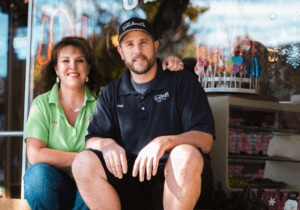
Kasey Pulliam-Reynolds and Nathan Reynolds of Shubert’s Ice Cream & Candy.
Indeed, Shubert’s is a North State icon, with lines regularly wrapped around the block on summer evenings to enjoy one of its 30-odd varieties of ice cream and 30 more kinds of hand-made candy. In fact, 10 years ago, it was recognized by ABC’s Good Morning Americaas one of the nation’s two best ice cream stores.
Still housed in its original downtown location, the Pulliam family this year finally opened a second location in the city’s major shopping mall to meet the demand.
Reynolds said the secret to Shubert’s continuing popularity is the family’s commitment to quality.
“Everything is made on site and only family members and one other person make our products,” said Reynolds, who handles the marketing and business end of the business while her brother, Nathan Pulliam, is in charge of production.
All the candy and ice cream are still handmade using many local ingredients, including butter, cream, honey and nuts. Even the seasonal treats, such as boysenberry sundaes in the spring, watermelon sherbet in the summer, and pumpkin ice cream in the fall, contain locally grown produce to give them that distinctive homemade taste.
Family members have been deeply involved since the beginning. After a Depression-era insurance business in Montana failed, Shubert purchased an ice cream machine and headed west to find a location. When he drove into Chico, with its tree-lined Esplanade, he knew it was where he wanted to build his business.
(Reynolds notes the original ice cream machine is still in use and is a secret to the business’ success as it makes a different product than more recent machines.)
As business grew in the late ‘30s and early ‘40s, Shubert brought family members out from Missouri to help out, including a nephew, Charles Pulliam, who eventually bought the business. Pulliam’s son, Chuck, took over from his dad and now the fourth generation is in charge.
While Nathan had been working at the store since high school, Reynolds spent some time in Corporate America, noting that having five family members working together was enough (grandpa, grandma, mom, dad, and brother all worked at the shop). She worked for large companies for several years until her mother died suddenly.
Because Reynolds was the only family member who had been taught how to hand-dip chocolates, she came back home. In fact, the candy side of the operation – almost a separate business – has been an important part of Shubert’s success over the years, as it keeps the customers coming in over the holidays and at Valentine’s Day when ice cream sales are low.
And that blend of ice cream and candy came together nicely in perhaps Shubert’s signature product – Chico mint ice cream, a reversal of most mint-chip ice creams because it’s chocolate ice cream with chips from the company’s handmade mint candy.
As with most family businesses, there are advantages and disadvantages to owning your business.
“There’s a lot of hard work and there are times the kids have to sacrifice and maybe not go on vacation when their friends do, but next Thursday I get to be a field trip driver when other parents don’t have that kind of flexibility,” she said
She joined FBA because she believes small businesses need a bigger voice.
“I used to do a lot of advocacy, but now that the business has grown and I don’t have time to fight for small business, I thought it would be important to join an organization that is acting as my eyes and ears about what is going on in Sacramento while I’m running my own business,” she said.
Reynolds is still directly involved in advocacy, however. She’s running for a seat on the Chico City Council this fall and while distressed about some recent vandalism around the store by people opposed to her right-of-center views, she is feeling good about her campaign and hopes to be able to bring diverse groups together if elected.
While there are many reasons why healthcare spending is growing much faster than the economy — including an aging population and the rising cost of prescription drugs — one problem that gets virtually no attention and is a primary cost driver is cross-subsidies. The reason cross-subsidies exist in the first place is because lawmakers want to subsidize healthcare costs for the poor, the sick, and other potential voters — which is well-meaning — but do not want to raise taxes to pay for these programs. So they hide the taxes they should impose in the form of cross-subsidies.
Elliot Eisenberg
Let me explain. If someone with no money walks into an emergency room and needs care, they get care. But to recover the cost of services provided to the indigent, hospitals must overcharge everybody else. Making matters worse, Medicare and Medicaid (MediCal in California) do not pay the full amount of their service cost. As a result, hospitals must substantially overcharge everybody else, and that unlucky bunch is patients with private insurance and those who pay cash.
Of course, giving free or subsidized healthcare to some by overcharging paying customers is essentially imposing a tax on those who can pay in order to subsidize those who can’t or won’t. But — and this is the key — this hidden tax does not appear anywhere. As such, it is politically costless, and that’s why it is so appealing to politicians. If that were all, it would not be so bad. But it gets worse, much worse.
Cross-subsidies are much more inefficient than raising taxes and spending the revenue on, in this case, healthcare. Here’s why. In an ideal market, if a hospital or doctor is going to overcharge some patients, those patients will have an incentive to shop around for a cheaper insurance plan. That insurance plan could be cheaper if it sends patients to hospitals and doctors who don’t overcharge. But if enough such plans were to exist, the entire system would fail because these new low-cost providers would drive the high-cost providers out of business and the poor would not be served. Thus, the introduction of cross-subsidies must be accompanied by a prohibition on competition. One of the ways we see this lack of competition manifesting itself is insurance plans such as bronze, silver, and gold all offering the same services.
And once there is no competition, there is no incentive for any non-competitive service providers to innovate for better care or lower costs, and that, in turn, drives up costs for everyone. If you are old enough, you remember that prior to the 1980s, local phone calls were cheap, often free. That was because long distance calls were very expensive; there was cross-subsidy from long distance calls to local calls. Of course, firms wanted to compete to provide overpriced long-distance calls, but the system would have unraveled. So the federal government gave AT&T a monopoly and, in that way, kept competitors out and prices up.
Once there is no competition, be it in telecommunications, airlines, trucking, banking, or stock trading, inefficiencies multiply and prices rise. Returning to healthcare, because of this lack of any meaningful competition, consumers know the cost of nothing they consume and care even less. What kind of market operates well when prices are well hidden? If there were real price competition, consumers would be bombarded with ads boasting of better prices and outcomes and we would all be winners.
Increasing taxes and spending, while hardly ideal, sure beats cross-subsidies and the attendant monopolies that drive up costs, prevent firm entry, and eliminate innovation. Until cross-subsidies are eliminated, U.S. healthcare costs will continue to spiral out of control and we will be able to do nothing more than wish for a competitive, innovative and efficient healthcare market.
Elliot Eisenberg, Ph.D. is President of GraphsandLaughs, LLC and can be reached at Elliot@graphsandlaughs.net. His daily 70-word economics and policy blog can be seen at www.econ70.com. You can subscribe and have the blog delivered directly to your email by visiting the website or by texting the word “BOWTIE” to 22828.
Early in the morning of September 1, the 2018-19 legislative session was gaveled to a close. During the last month of session, the Legislature acted on over 1,000 measures, the majority of which made it to the Governor. All of the approved bills are on or heading to the Governor’s desk and he has until September 30 to sign or veto them. While Governor Brown is known for being fiscally moderate there could be some surprises this year given his lame-duck status.
At the end of this signing session, the Governor will have acted upon a total of 1,217 Assembly and Senate bills for the 2018 year. There are 2,739 bills that are dead, having failed to meet their respective legislative deadlines or vote thresholds. A breakdown of key issue areas and legislation for the Family Business Association of California is provided below.
Energy
The cost of energy in California remains a significant issue for businesses. However, California leaders maintain their enthusiasm over leading the world on greenhouse gas reduction legislation. FBA weighed in on several proposals and on the eve of the Governor’s Global Climate Summit he signed significant legislation.
SB 100 (De Leon) requires California to obtain 100% of its power from zero greenhouse gas emission sources by 2045. The bill has been debated by lawmakers for nearly two years as it faced cost and feasibility concerns. In addition to the 2045 target, SB 100 would also require electric utilities and other service providers to generate 60% of their power from renewable sources by 2030, up from the current 50% goal set for that date. CHAPTERED The Governor’s signing message for SB 100 can be found here.
Labor
FBA has been engaging in several labor legislative issues this year working with coalitions to oppose many and support a few such as PAGA reform.
AB 2841 (Gonzalez-Fletcher) would have mandated an increase in paid sick leave from 3 to 5 days per employee per year. The bill faced incredible opposition from the business community and ultimately died in Assembly Appropriations.
AB 3080 (Gonzalez-Fletcher) would have significantly expanded employment litigation and increased costs for employers and employees by banning settlement agreements for labor and employment claims as well as arbitration agreements made as a condition of employment. The bill died in Assembly Appropriations.
SB 1284 (Jackson) would have required California employers to submit pay data to the Department of Industrial Relations, subjecting employers to unfair public criticism, enforcement measures, and significant litigation costs. The bill died in Assembly Appropriations.
SB 1300 (Jackson) would significantly increase litigation by substantially lowering the standard for what constitutes standing to sue an employer for harassment or discrimination from “severe or pervasive” to “makes it more difficult to do the job.” This bill also bans the use of non-disparagement agreements and attempts to limit the ability to summarily adjudicate harassment claims forcing employment practices claims into court or costly settlements. These claims are very expensive to investigate and defend, even if there was no actual wrongdoing by the employer. The scope of this bill was significantly narrowed in the Assembly Appropriations Committee by removing language requiring employers to provide sexual harassment training, including bystander intervention training, as well as eliminating language that individuals could sue employers without having endured harassment or discrimination. The bill is on the Governor’s desk awaiting signature.
AB 2613 (Reyes) would have imposed another layer of Labor Code penalties for wage and hour violations in addition to the penalties already available under PAGA and imposed personal liability onto employees. Due to strong opposition, the author never brought the bill up for a vote.
Taxation
Tax policy continues to be a leading issue for FBA and area of major discussion at the Capitol. FBA led the fight against the estate tax earlier this year and maintained the fight on the measures that continued to receive attention all session.
SB 993 (Hertzberg) was another attempt to shift to a tax on services. The measure would have expanded the sales and use tax law to impose a tax on the purchase of services by businesses in California. The bill would have exempted certain types of services, including health care services, from the tax. In a twist over his previous legislation, Hertzberg directed the funds to be appropriated to provide tax relief to middle-income and low-income Californians. The bill was never brought up for a vote. Informational hearings were scheduled instead to research the issue further but never took place.
SCA 24 (Galgiani) would have created financial hardships for family businesses and farms that could have resulted in liquidation of the business and loss of jobs for the employees. SCA 24 would have limited the exclusion not deemed to be a “purchase” or “change in ownership” for the purchase or transfer of a principal residence from parents or grandparents to their children, and would have required it to continue as a principal residence of the transferee. The measure also would have deleted the exemption on the first $1 million of the full cash value of all other real property, including family businesses and farms, thereby requiring these properties to be reassessed upon a transfer to a child or grandchild. The bill was never voted on.
Water Tax Fails. Governor Brown tried and failed to secure a deal to provide safe drinking water funding for disadvantaged communities in California. After failing to win approval of a mandatory tax on water bills earlier this year, Senator Monning introduced SB 844and SB 845 in the last two weeks of the session that would have applied a voluntary levy on ratepayers of less than $1 per month and would have established a tax on dairies and fertilizer manufacturers. The bills were held in the Appropriations Committee but Assembly Speaker Rendon released a statement saying that they will work on this issue over the fall and be prepared to discuss the issue during the next legislative session.
Family businesses are often the pillars of their community. A case in point is Peterson Holding Companies, the parent firm of FBA Member Peterson Cat. The company was founded in 1936 by founder and company namesake Howard Peterson and now his grandson, Duane Doyle, is the company president.
Peterson Holding Company, and all wholly owned subsidiaries (“Peterson”), are committed to partnering with nonprofit and charitable organizations within the communities we serve. To request a consideration for a donation or equipment rental for your organization, please complete this application and return it to Peterson in the Community by email, fax, or mail.
Among the numerous charities and nonprofits the company has assisted over the years are TLC for Kids Sports, Miracle League of the North Bay, the National Breast Cancer Foundation, the Susan G Komen Foundation, the Salvation Army, and the Oakland Zoo.
Statistically, family businesses are far more likely to give back to their communities. They are based there, not in a city half a continent away, the owners have likely lived there for generations. They have deep roots.
FBA salutes Peterson and all its members for their community involvement. And we remind state lawmakers and regulators that this is just another reason why California should encourage family businesses to thrive from generation to generation, not hinder them.