FBA Government Affairs Chair Grant Deary testified last week before the Senate Governance and Finance Committee in opposition to SB 993 (Hertzberg). The bill would impose a 3 percent tax on professional services purchased by businesses in exchange for a 2 percent reduction in the statewide sales and use tax. The bill has already been given the “job-killer” label by the California Chamber of Chamber due to tremendous impact it would have on all businesses in California.
Deary, who of nearly 50 speakers in opposition to the bill was the only business owner, testified on behalf of the FBA and discussed the specific impact on family businesses that may contract out professional services at a higher rate since several may not have the in-house expertise of multinational firms or to reduce needs for capital. In addition, he made reference to the challenges that firms like his, Nor-Cal Beverage, may have in apportioning the tax on contracts that contain both a good, that is untaxed, and a service, that may be taxed. This will increase tax liability and the entire bill will have significant compliance costs to family businesses.
While proponents argue that this service tax would only “target high-end services” — such as lawyers or accountants — these services are a part of doing business and the definitions in the bill of “qualified businesses” are broad. The result of any tax increase means increased costs for customers or businesses paying the difference. While the measure does include some exemptions including utilities, equipment, and machinery repair, as well as services necessary in food production, the result will still be higher costs. SB 993 also creates confusion for multistate businesses because the service tax only applies to services received in California. Additionally, all businesses will have increased costs of compliance attempting to understand and implement the tax requirements.
The hearing, which lasted nearly two hours and included robust discussion on all sides of the issue, was the first in a series of hearings intended to hear feedback on the proposed bill. The next hearing will take place on June 13.
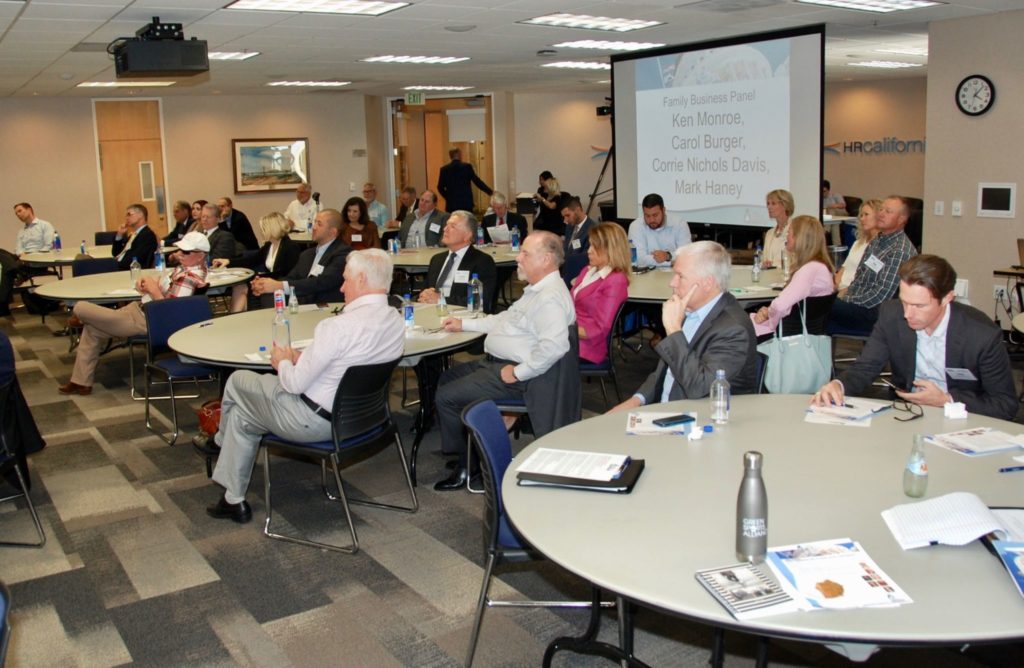
FBA is earning the respect of business allies and opponents in the never-ending struggle to enact pro-business legislation and defeat bills that would make it even harder to do business in California, the Association’s lobbyists told FBA members on May 2 during the sixth annual Family Business Day event.
“We’re now getting called by the state Chamber of Commerce to ask us to testify on their bills,” Dennis Albiani told about 70 members and guests at the afternoon conference in downtown Sacramento. “There is a brand that family businesses have and that’s a nice dynamic.”
Albiani and fellow lobbyist Faith Lane Borges said FBA is focused on several key issues this year:
• Continuing our leadership role to prevent a state inheritance tax from being enacted.
• Fighting proposals to weaken Proposition 13 and enact a split roll that would allow business properties to be reassessed more frequently.
• Regulatory relief.
• And supporting workforce development.
So far this year, FBA leaders and lobbyists have held 15 one-on-one meetings with lawmakers, building relationships that are essential educating lawmakers about the impacts on family businesses.
Albiani and Lane updated attendees about key bills that are still pending this year.
FBA opposes numerous bills, including ACA 22, which would more than double the state’s corporate tax rate; SB 993, which would impose a tax on most services purchased by businesses; SB 1284, which would require employers to report wages paid to employees to the state, which could be used to subject businesses to unfair criticism and litigation; and AB 2841 that would expand the number of paid sick days from three to five, while allowing local governments to adopt more stringent requirements.
The Association supports a number of bills as well, including AB 1743, which would continue funding for career technical education, and AB 2023, which would make the child care tax credit refundable, meaning more working families could benefit from a tax refund.
Martin Wilson
Martin Wilson, the executive vice president and chief political strategist for the state Chamber, walked attendees through a number of statewide and legislative races taking place this year, including the race to replace Gov. Jerry Brown, where Democratic Lt. Gov. Gavin Newsom is almost certain to be one of the top-two vote-getters in June but the second finalist could be a Democrat as well.
“Newsom’s support of split roll and imposing a services tax on business people should be very worrisome to you,” Wilson told attendees.
He also said polling clearly shows that Californians are generally liberal but still have a conservative bent on many issues. He said the major issues voters identified were immigration, the economy, politics and corruption, and taxes. They are not hearing enough from candidates about crime, job creation, building more highways, and keeping energy costs low – but are hearing too much about making California a sanctuary state for undocumented immigrants.
“The gas tax increase is very unpopular,” he noted.
Sam Shane
Also speaking was former TV anchorman Sam Shane, who now consults with businesses on communication strategies. He urged businesses to ensure their websites were informative and up to date since a majority of consumers visit them to find out more about a company for making a purchase.
In addition, he said it’s more important than ever to use video online and in social media. Research shows that 90 percent of shoppers find video helpful in making buying decisions and Internet video now makes up 79 percent of global consumer Internet traffic.
With cell phones and computers, businesses have the tools they need to produce quality videos in-house or by hiring a firm to assist. He said it was particularly important to make sure website and video are professional and attractive because unattractive content can chase customers away.
Ken Monroe, Mark Haney, Carol Burger, and Corrie Nichols Davis
New this year was a panel discussion moderated by FBA Chair Ken Monroe that featured Carol Burger, owner of Burger Rehabilitation Services; Corrie Nichols Davis, managing partner and chair of Gorrill Ranch; and serial entrepreneur Mark Haney who now specializes in helping Saramento-area entrepreneurs discussing how they survive in California.
Davis, whose family has owned its farming operation for four generations, said one thing business owners should do is build relationships with regulators, so you can educate them about how regulations affect your business and work with them to come up with solutions that achieve the goal without significantly harming your operations.
Haney said lawmakers should relax tough overtime laws that even employees think are too restrictive and instead give employers more flexibility.
Asm. Frank Bigelow, FBA CEO Robert Rivinius, and Asm. Steven Choi at reception.
And Burger said business owners should engage in lobbying. “When you go in and start complaining, they’ve heard that before but they don’t know what to do to solve the problem. The hard part is telling them ‘this is what I need.’ The answers are complex and you really need to have a plan for what you need.”
At one point, Monroe quipped, “So what you’re saying is in spite of these guys across the street (in the Capitol), we’re going to be successful.”
State Sen. Ted Gaines – an FBA member – wrapped up the session with a few insights about activity in the Legislature.
The day concluded with a legislative reception that featured a number of lawmakers in attendance.
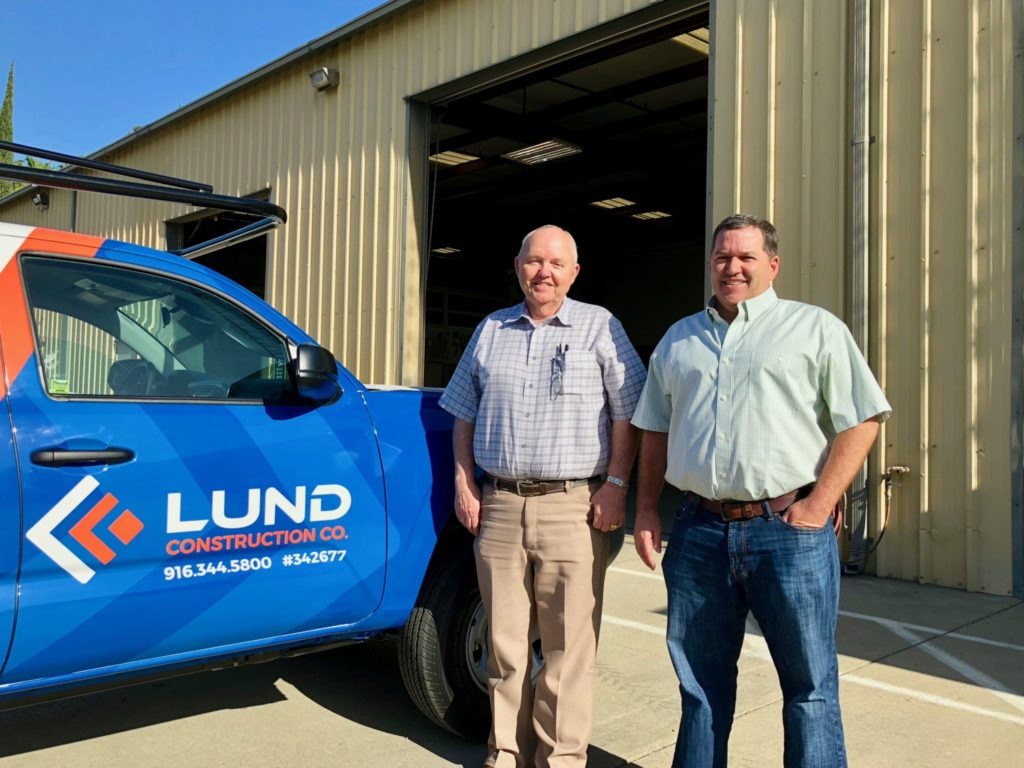
Now in its third generation and celebrating its 60th year in business, Lund Construction Co. – like so many family businesses – began as a home-based business. The year was 1958 and George and Alta Lund began the Sacramento-area business with just a motor grader and a tractor.
After working on and off as an operator and supervisor for several West Coast construction firms, George finally decided to take the plunge and start his own company. With his wife Alta by his side handling the books, until her recent retirement at the age of 90, their vision of a family-operated business was key to its early success.
Jerry and Kevin Lund
“When my dad got started, being a family business meant customers were accessible to the owner and you had a personal relationship,” recalled George’s son, Jerry, who still serves as company president while having turned over most of the day-to-day operations to his son, Kevin. “With a personal relationship, you built trust in what the other person said, and deals were sealed with a handshake.”
At first the company specialized in small grading and paving jobs, but eventually expanded into grading subdivisions and custom-home lots to house the region’s rapidly growing population.
A Lund grading project in Rocklin.
Now 60 years later, Lund’s full scope capabilities, extensive fleet and over 100-person crew allows the company to self-perform all projects for residential and commercial developers, general contractors, and municipalities across the greater Sacramento region.
Recently the company has completed several large projects across all sectors they target, including residential subdivision work for large, national builders. This includes completed site work for a 120-lot subdivision for one development project, and mass excavation with utility installation and the largest redi-rock precast wall in Northern California to date for another project.
But the company also works closely with the public sector. For example, Lund has been working on a multiyear project with SMUD as part of their annual cable replacement program to replace pull boxes, vaults, and conduit that were direct-buried in the ground 50 years ago.
Lund excavation below Oroville Dam.
Lund also played a major role in clearing debris from the Feather River immediately below the Oroville Dam spillway after it collapsed in early 2017. Immediately afterwards, the company built haul roads and access roads to allow for excavation and removal of 750,000 cubic yards of debris. At the project’s peak, Lund had more than 40 people in the field and office to support a 24-hour, 7-day/week schedule for eight weeks.
As is the case in many family businesses, both Jerry and Kevin began working for their dads while they were still very young.
“As a boy, who wouldn’t get excited about driving tractors? I grew up on a tractor and worked from the time I was 12,” Jerry said. “It was the same as a boy having to mow the lawn after school, only more exciting.” He began working full-time when he graduated from high school in 1964, and by the mid 1980s was running the company.
Following his dad’s vision of remaining a family-run business, Jerry had his twin sons, Kevin and Jeff, follow suit and begin work when they were 15.
“The construction business always intrigued me,” Kevin said. “I like being outdoors on the job sites because the people we work with get up early and work hard, but we also have fun. Our crew is an extended part of our family.”
Of course, there was a learning curve.
Staying true to the Lund way of remaining hands-on in daily operations, Jerry had Kevin learning the business on various job sites as an equipment operator. One included a project to tie into a PG&E gas line in Roseville.
As the project began, the PG&E foreman requested the job supervisor provide a seasoned operator for digging around the high-pressure gas line. Kevin wasn’t thrilled about this since he’d been doing good work for some time on several projects.
“At one point, he came over to me and said that it didn’t matter that much to him or to me if I made a mistake because the fireball would kill us instantly, but perhaps I should think about all the other workers and the company,” he recalled with a chuckle. “The project ended with no explosions and I am happy to have learned what I did in the field to help me run the company.”
Because the Sacramento area continues to grow and offer an abundance of work, Kevin and Jerry have decided to focus primarily in the region to contribute to that growth. “Our goal is to continue to promote a healthy work-life balance for our employees by sending everyone home each night, combined with a sense of pride on the projects they are building within their greater community,” Kevin said.
To mark the company’s anniversary, Lund recently unveiled a new logo that replicates a diamond road sign, with elements that stand for their core principles: the tradition and experience the company is based on; the safety of employees and the environment; and growth in the future of the company and region.
And the future is one reason why Lund joined FBA in 2014. Like most California businesses, the state’s increasingly stringent tax and regulatory climate make it difficult to stay profitable.
“No matter how big we think we are, to be heard by the legislators or the air quality regulators is almost impossible without belonging to an organization with strength,” Jerry said.
“You need a strong voice,” Kevin agreed. “Being part of FBA is a great way to get your voice heard.”
Elliot Eisenberg | GraphsandLaughs, LLC | May 2018
Editor’s note: Here is economist Elliot Eisenberg’s latest column for FBA members.
With the U.S.-China trade war looking increasingly ominous, two questions are on the minds of many: do trade deficits matter and which side has more to lose? Economists of almost all stripes agree that trade is good, that trade deficits don’t really matter, that the nation that imposes tariffs hurts itself, and that if it faces retaliation, the harm is made worse. That said, why is Trump threatening steep tariffs on Chinese imports? That relates to the second question: China has much more to lose economically in an all-out trade war than the U.S. But that is not the end of the story.
Elliot Eisenberg
Chinese exports to the US totaled $500 billion in 2017, 4 percent of its GDP. Our exports to China were just $130 billion, or 0.7 percent of our GDP. Moreover, U.S. exports to China are not so easily replaced. China can easily stop buying planes from Boeing and instead buy them from Airbus, but then China has no leverage. And while China can stop buying soybeans or oil from the U.S., those markets are global, and the impacts would be minimal.
China could conceivably sell U.S. Treasuries they hold, but, at a minimum, that would push up China’s currency, which would, in turn, hurt exports, and might plunge the U.S. into a recession, further slowing exports. Finally, if China retaliates against American firms, global manufacturers might no longer consider China as a safe place from which to sell to the U.S. The resulting loss of foreign investment would hurt Chinese productivity growth and acquisition of foreign technology and industrial know-how.
If economically everything looks to be in favor of the U.S., what’s the problem? Politics. And there, things are very different. If the economic leverage is with the U.S., the political leverage rests fully with China. Chinese leaders do not have to worry about elections, constituents, critical editorials, or Sunday morning talk shows. On the contrary, when China was angry at South Korea for placing a U.S.-owned anti-missile defense system on their territory, China simply shut down a whole chain of South Korean department stores and Chinese tourists stopped showing up in Seoul. And when China was mad at Japan, rioters attacked Japanese-owned factories and Chinese purchases of Toyotas and Nissans shriveled to nothing in remarkably short order.
Now, the U.S. is not Japan or South Korea, so things are much more complicated, but the Chinese are strategically ready. They are responding to our tariffs by, among other things, deliberately slapping import taxes on products made in states represented by key congressional Republicans, such as whiskey from Mitch McConnell’s home state of Kentucky and Harley-Davidson motorcycles, since they come from Wisconsin, the home state of House Speaker Paul Ryan. China’s strategy is to get enough constituents, farmers, and business leaders mad at enough Members of Congress in general and Republicans in particular to pressure Trump to back down.
Domestically, there is simply no way China can be seen as folding under American pressure. On the contrary, President Xi faces pressure to project China as a world power. And true to form, the Chinese are quickly seeing and raising the tariff ante. As such, China is saying they will not back down, are prepared to suffer any financial costs, and are prepared to play a long game. For Trump to win under these conditions, he will have to be prepared to tolerate a great deal of political pain if his demands are not met, and convince the Chinese that his pain tolerance and endurance is greater than that of Beijing.
My bet is that the Chinese either play to Trump’s ego and give him a series of symbolic but largely hollow victories, or that China makes concessions they have offered in the past, but (importantly) offer no timetable for implementation and skirt the core US complaints. That way Trump can claim he has won, but the status quo will essentially be maintained. And in that case, the Chinese will have emerged victorious. Let the games begin.
Elliot Eisenberg, Ph.D. is President of GraphsandLaughs, LLC and can be reached at Elliot@graphsandlaughs.net. His daily 70-word economics and policy blog can be seen at www.econ70.com. You can subscribe and have the blog delivered directly to your email by visiting his website or by texting the word “BOWTIE” to 22828.
While Lippow Development Co. is officially celebrating its 70thanniversary this year, the Martinez-based family business really began decades earlier, when family patriarch Leo Lippow opened a bike shop outside of Milwaukee, Wis. During the first decade of the 20thcentury, that same bike shop morphed into one of the nation’s first Harley-Davidson dealers.
As company President and CEO Larry Lippow (third-generation owner) remembers, the saga was far more all-American than owning a bike shop that also sold Harleys.
Larry’s grandfather, Leo Lippovaski, was a Polish Jew living in the Russian Empire, a country marked by pogroms and less-violent anti-Semitism at the turn of the 20thcentury. Leo wanted to start a new life in America and saved up enough money to buy passage on a ship for himself and his mother. Together, they sailed into New York Harbor in 1904.
“They came through Ellis Island and brought all of their belongings in one suitcase,” Larry said. Like so many immigrants, the clerk decided that their family name was too foreign for America and changed it to Lippow.
“He just marked his name with an X and when he was done he turned around and saw someone had stolen their suitcase. He and his mother had literally nothing except a few coins in his pocket,” Larry said, noting that the family has passed that story down from generation to generation to remind everyone that what they have was built on the backs of their forebears.
Leo Lippow’s bicycle store outside Milwaukee.
An interior view of the shop.
The new arrivals had relatives in the Milwaukee area and somehow found transportation. When they arrived, Leo soon approached the owner of a nearby bicycle shop (as the Wright Brothers knew, an important business at the time) and made a proposal. If the owner would allow Leo and his mother to live in the back of the shop free of rent, Leo would work for free and only ask to be taught the business.
A year or so later, the bike shop owner decided to sell the business and the property and Leo made another proposal: to buy both and pay the seller over time. The deal was consummated. Leo quickly grew the business by adding Harley-Davidson motorcycles to his inventory. In an effort to promote the sale of motorcycles, Leo formed one of the country’s first motorcycle clubs to go on rides together and to also have motorcycle races.
He also married, and in 1914 the couple’s only son, Sidney, was born. Sidney had lung problems and their doctor suggested the family relocate somewhere warmer. So, Leo took a train to Southern California to investigate the area and experience the warmer climate. He wound up in a bar in Orange County. Over drinks, a man offered to sell Leo a piece of land, and thinking that it would be a good location to build a bike shop, Leo decided to make the purchase.
“The next day or so, somebody offered him twice as much for the land and he took it. That planted a seed that the real estate business in California might not be a bad idea,” Lippow said.
Leo decided to visit other parts of the Golden State before deciding where to settle down, and to pay for his travels bought a few shares in a bus line that eventually became Greyhound. Shareholders could ride for free, so Leo traveled up the coast and a few days later wound up in another bar, this time in Willows, northwest of Sacramento.
“The owner of the Palace Hotel, restaurant, and bar was also the mayor, and he told my grandfather that he wanted to get out of real estate and focus on politics, so that night my grandfather bought the property and the next day he wired for his family in Milwaukee to pack up and move to Willows,” Lippow said.
There was, however, a problem once the family got settled in Willows. As observant Jews, the Lippows wanted to attend temple, but the closest synagogue was in Sacramento, a long and dusty motorcycle ride away. Eventually, they bought the Traveler’s Hotel in Martinez and the Grand Avenue Garage in Oakland. The family moved to Piedmont and became active members in the synagogue in Oakland.
After graduating from Piedmont High School, Sidney was awarded a football scholarship to attend USC. He only attended for two years before Leo wanted Sidney to come home and start working in the family business. Shortly afterwards, the family moved to Martinez to actively participate in the management of the Traveler’s Hotel and other real estate purchased in the Martinez area.
Leo acquired and sold commercial and residential real estate over the following years and the business flourished. Like many entrepreneurs, Leo wanted to keep control and when he finally formed a corporation in 1948 he kept all the voting stock, giving non-voting stock to other family members. When he died in 1961, Sidney inherited the voting shares. Under Sidney’s watch, the family business continued to grow and expanded its holdings throughout Northern California.
After graduating from the University of Arizona in 1978, Larry turned down an offer from IBM, decided not to pursue an opportunity to attend law school in Arizona, and came home to the Bay Area and work with his dad, and did so until Sidney died in 1986. The company continued to grow and do well after Sidney’s passing.
“I was under the impression we were a big, happy family. Shortly after my dad died I started getting calls from relatives who said they’d always told dad he should have diversified or done things differently. I finally realized that many of our family members wanted to cash in and do other things,” he said.
With the support of his younger sister, Laura Lippow Babiak, Larry decided to give his family members one opportunity to sell 100 percent of their shares in the family business, but he thought the power of the family story would keep most of them together. So he wrote a book about the company’s first 50 years, had copies made for everyone, and made each promise to read it from front to back and then decide in 60 days if they wanted to sell or stay.
“When the day came, I really thought most would remain as shareholders in the family business, but all sold but my younger sister and me. We went from 25 owners to two. I was devastated,” he said.
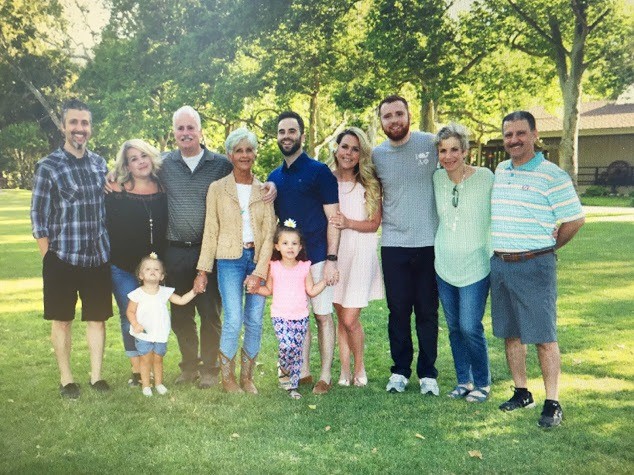
The Lippow family today.
But in the long run, it was a good thing because Larry and Laura were able to move in one direction as a team without any distractions from other owners. In an effort to help ensure the continuance of the family business for the future, Larry and Laura implemented two key things learned from their previous experience dealing with discord from family owners. First, create a buy/sell agreement that clearly spells out shares’ values and method of payment over time that will provide the flexibility to allow the family business to continue to operate in the future and at the same time offer shareholders a tool for liquidity should they decide to sell their ownership interest in the family business. Second, appoint outside and independent directors to its Board of Directors to make sure that the company’s policies are created for the benefit of the business first, and not for the benefit of any specific family member.
“When it comes to corporate governance, I find so many family businesses need help. When you mix in family dynamics on top of the business dynamics, it’s very challenging. I’ve discovered many family businesses are very successful in operations and make a lot of money, but as far as succession planning for owners and formal governance the family businesses usually are weak and sometimes quite dysfunctional,” Larry said. “The lack of communication between family members in regards to succession planning and the need for formal governance always amazes me.”
The company. has expanded from the Bay Area to Arizona in recent years, partly because of California’s growing regulatory burdens and high taxes. Larry remains optimistic about the business, noting he and his sister each have two children and have spent much time trying to educate the next generation about the difference between being an owner in the family business and an employee in the family business. In addition, there has been much discussion in the family about promoting the concept of stewardship. Several of the fourth generation have expressed some interest in becoming active in the management of the family business.
Larry said Lippow Development Co. joined FBA because it’s a great platform to remind lawmakers and regulators that family businesses are huge job creators, tax revenue generators, and entrepreneurs who try to remain nimble and flexible to be able to survive for the long term, both in good and bad economic times.
“If our state government would lower the income tax rate and minimize the many other taxes, fees, rules, and regulations, it would help family enterprises to thrive in California, thereby producing many more job opportunities and revenue for the state. It’s already hard enough to be successful in business, but every year it’s more challenging, especially here in California. I’m not sure some legislators appreciate or understand how their actions impact small businesses,” he said.
In the meantime, Larry continues to love the real estate business. The firm recently sold its last apartment complex and now is focused solely on commercial investments.
“When my kids were young and would bring me to class for show and tell, I would be asked what I do in business. I would say I play Monopoly for a living. I try to pass Go and collect $200 as many times as I can and definitely want to stay out of jail because there’s no get-out-of-jail free card in real life,” he said.
Larry looks forward to the future and takes pride in building Lippow Development Co.’s legacy with inclusion of the fourth generation of the Lippow family. At the same time, it is important at all times to educate and remind the family of the previous Lippow generations’ sacrifices made for the family business and the family’s humble beginnings in the United States, and that these values and idea — along with the opportunity to continue to play Monopoly, whether that be in California, Arizona, Nevada, Utah, or Texas — still gets him excited to go to work each and every day.

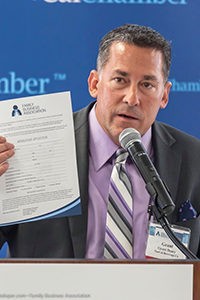 FBA Government Affairs Chair Grant Deary testified last week before the Senate Governance and Finance Committee in opposition to SB 993 (Hertzberg). The bill would impose a 3 percent tax on professional services purchased by businesses in exchange for a 2 percent reduction in the statewide sales and use tax. The bill has already been given the “job-killer” label by the California Chamber of Chamber due to tremendous impact it would have on all businesses in California.